GemRaid - Free spins, coins, and gift codes that actually work.GemRaid - Free spins, coins, and gift codes that actually work.GemRaid - Free spins, coins, and gift codes that actually work.GemRaid - Free spins, coins, and gift codes that actually work.
Let's cut through the BS immediately: No, Dice Dreams doesn't pay you a damn cent directly.
But — and this is crucial — you can make legitimate money playing it. I've seen players pull $100-$300+ by understanding how the system actually works. This isn't about magic hacks or sketchy generators. It's about exploiting the user acquisition economics that power mobile gaming.
Here's everything you need to know.
Why the App Itself Never Pays (And Never Will)
Tags
You might also like
More guides and updates to help you stay ahead.
SuperPlay's Terms of Service are crystal clear: Every virtual item in the game — dice rolls, coins, shields, stickers — has zero real-world value. You don't own them. You're renting them, and SuperPlay can revoke them anytime.
The legal language explicitly states: Virtual items cannot be redeemed, cashed out, or exchanged for money. Period.
This protects SuperPlay from gambling regulations and means when your game crashes or your tournament prizes vanish, you have zero legal recourse. Check their Trustpilot reviews — they're sitting at a dismal 1.5 out of 5 stars, with players constantly complaining about frozen accounts and ignored support tickets.
Bottom line: Any dollar you spend inside the app is gone forever. You're not investing — you're gambling on your own entertainment.
The Celebrity Ad Confusion: Why Everyone Thinks It Pays
SuperPlay dumps massive budgets into celebrity ads featuring Eva Longoria and Kate Beckinsale "stealing" coins and hitting "jackpots." The language deliberately mimics real-money casino apps.
While they never explicitly promise cash payouts, the rhetoric fuels confusion — and that confusion spawns thousands of scam sites advertising "Dice Dreams Free Rolls Generators" and "unlimited coin hacks."
Here's the truth: These generators are 100% fake. Dice Dreams uses server-side architecture — all your data lives on SuperPlay's encrypted servers, not your phone. Third-party sites can't manipulate it without breaching enterprise security (which would be federal crimes).
These "generators" exist to:
Steal your login credentials
Install malware on your device
Force you into premium SMS subscriptions through fake "human verification"
The Real Money Path: How Offerwall Platforms Actually Pay
Here's where it gets interesting. While the app doesn't pay, third-party platforms absolutely do — and they pay well.
How the Economics Work
SuperPlay generates an estimated $7 million per month in the U.S. alone. To maintain that, they need a constant stream of new players — not just installers, but deeply engaged users who'll eventually spend money.
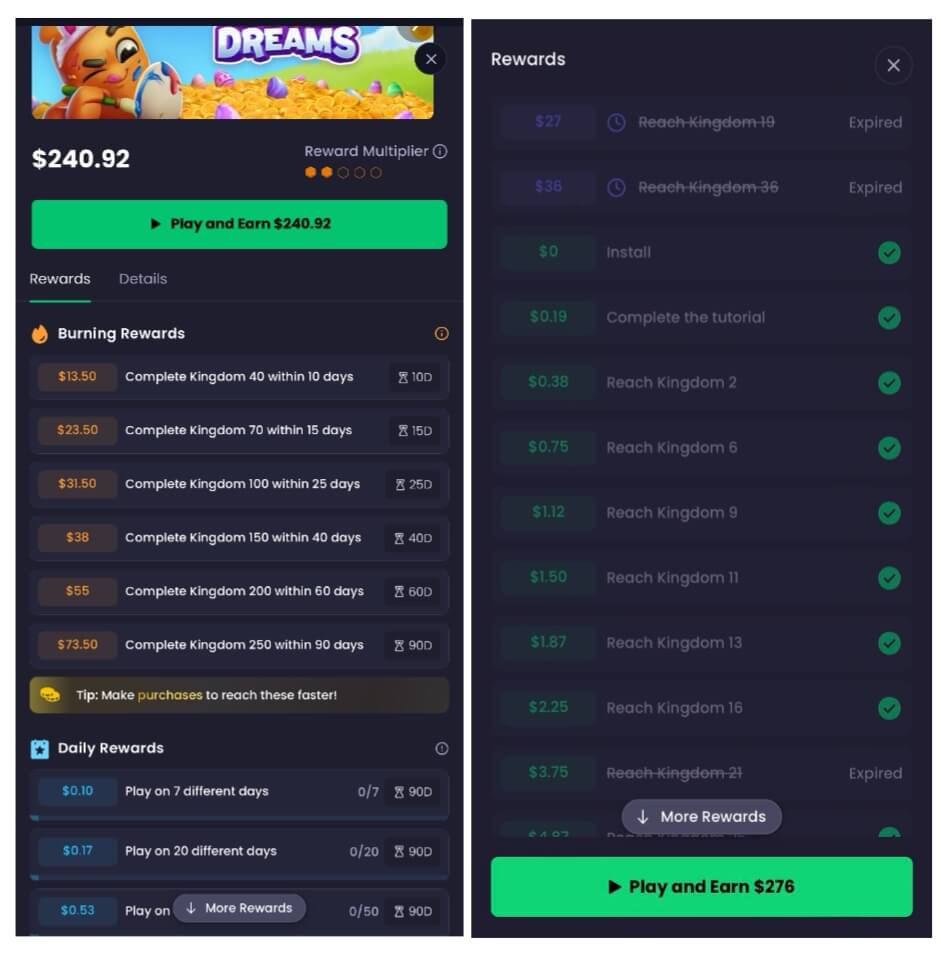
So SuperPlay contracts with marketing agencies and "offerwall" intermediaries (RevU, AyetStudios, AdGate). They agree to pay these companies a bounty for every user who hits specific milestones — like "Reach Kingdom 60 in 30 days."
The offerwall takes a cut and passes the rest to you through platforms like Swagbucks, Freecash, KashKick, or Scrambly.
You're essentially getting a rebate on SuperPlay's marketing budget. They're paying you to prove you're a valuable, high-retention user.
Where to Actually Make Money: Platform Breakdown
Swagbucks: The Marathon Strategy
Swagbucks offers tiered milestones with total earnings up to $313 for a full campaign. Here's the structure:
Milestone
Time Limit
Payout
Kingdom 1
30 days
$0.03
Kingdom 10
30 days
$0.03
Kingdom 20
30 days
$1.00
Kingdom 30
30 days
$2.00
Kingdom 60
30 days
$10.00
Kingdom 100
No limit
$20.00
Kingdom 250
No limit
$75.00
Bonus: Kingdom 29
1 days
$13.00
Bonus: Third purchase
10 days
$10.00
Early milestones are pennies —they're just testing that tracking works. The real money is locked behind high kingdoms or brutal speed challenges (Kingdom 29 in 24 hours is insane).
💡
Pro tip
Swagbucks runs a Member Recognition Program where loyal users get instant gift card delivery and points discounts.
Freecash: High Risk, High Reward
Freecash uses "burning" offers — they start at premium payouts (sometimes $150+) but depreciate 40% every three days.
This creates psychological pressure to play aggressively. Players report total earnings of $100-$150 if they can beat the depreciation timer.
The catch: Freecash has serious tracking issues. High payouts trigger SuperPlay's fraud detection algorithms, leading to frequent account audits and payment delays. You'll also see more "chargebacks" (explained later).
KashKick: Simple and U.S.-Only
KashKick displays everything in straight USD — no points conversion. Minimum cashout is $10 via PayPal or gift cards, processing in 1-3 business days.
Over 2 million users, clean mobile apps, but syncing between the game and KashKick dashboard can lag up to 24 hours. Check your progress manually.
Scrambly: Instant Gratification
Scrambly has the lowest barrier to entry — just $1 minimum cashout via PayPal or Amazon, processing in under 3 minutes. They add a +2% bonus for PayPal withdrawals.
Scrambly focuses on easier, earlier milestones rather than month-long grinds. Expect roughly $2-4 per hour of active play.
Mistplay: The Slow Burn (Android Only)
Mistplay doesn't pay for milestones — it pays for time played. You earn "Units" based on session length and loyalty level, converted to gift cards (not direct cash).
Average earnings: $1-3 per hour, with an annual cap around $550. It's better as passive background income than a serious earner.
The F2P Reality Check: When You'll Need to Spend
Reaching Kingdom 10-20 as pure Free-to-Play? Totally doable in 30 days.
Kingdom 40? You'll start feeling the squeeze.
Kingdom 60-100 in 30 days? You'll almost certainly need to spend money.
Here's where strategy shifts to arbitrage. If spending $15 on a dice bundle lets you hit a $40 milestone, you net $25 profit. Many players do this successfully.
Players routinely report reaching Kingdom 100 on Freecash with a $15-20 investment, securing payouts that far exceed their spend.
Kingdom 250? Mathematically impossible as F2P before the offer expires.
The Biggest Threat: Tracking Failures and Chargebacks
This is where players lose money — not from gameplay difficulty, but from technical and administrative disasters.
Tracking Setup (Do This First or You Won't Get Paid)
For offerwalls to pay you, they need an unbroken data chain from your initial click to the game's milestone servers. This relies on cookies and mobile ad identifiers.
Most tracking failures happen because privacy settings block this connection.
iOS Setup:
Settings > Privacy & Security > Tracking
Enable "Allow Apps to Request to Track"
When you launch Dice Dreams after installation, tap "Allow" on the tracking popup
In Safari settings, disable "Prevent Cross-Site Tracking"
Android Setup:
Settings > Google > Ads
Enable "Ad Personalization"
In Chrome settings, disable "Do Not Track"
Critical Rules:
Download the game through a clean Chrome or Safari browser
No VPNs, no ad-blockers, no DNS filters
Don't switch devices mid-campaign — this breaks the tracking chain permanently
The Chargeback Nightmare
Even with perfect tracking, you face "chargebacks."
Here's what happens: You complete a milestone. The offerwall pays you. Days or weeks later, SuperPlay flags your completion as "low quality" or "fraudulent" and refuses to pay the offerwall their bounty.
The offerwall responds by deducting the money from your account. If you already withdrew to PayPal, your account goes negative and you're banned until you repay.
Dice Dreams on Freecash is notorious for high chargeback rates. Players theorize that:
Finishing milestones too fast
Using auto-clickers
Clearing high kingdoms without making any in-app purchases
When milestones don't credit or you get hit with chargebacks, document everything:
Screenshots of your current kingdom level (uncropped, showing your progress)
Screenshots of your User ID from the game's settings menu
Email receipts of any in-app purchases (proves you're a legitimate, valuable player)
Submit a support ticket through the offerwall platform (not SuperPlay — their support is useless). Some players only win disputes by escalating to the Better Business Bureau.
The Bottom Line
Dice Dreams doesn't pay real money directly — but the offerwall ecosystem absolutely does.
Here's the framework for success:
Pick your platform (Swagbucks for marathons, Freecash for high risk/reward, Scrambly for quick cash)
Configure tracking perfectly (disable all privacy blockers, use clean browsers, don't switch devices)
Be prepared to spend strategically (calculate arbitrage: $15 spend for $40 milestone = $25 profit)
Document everything (screenshots, receipts, User ID — essential for disputes)
Reaching Kingdom 20-30 as pure F2P? Absolutely doable with daily engagement and event timing.
Kingdom 60-100? Expect to invest $15-30 strategically for $100+ total payouts.
Kingdom 250? Forget it without serious capital or months of grinding.
This isn't passive income. It's a strategic operation. Treat it like arbitrage, not entertainment, and the money is real.
But if you're looking for a game that magically deposits cash into your PayPal? That doesn't exist — and anyone promising it is running a scam.