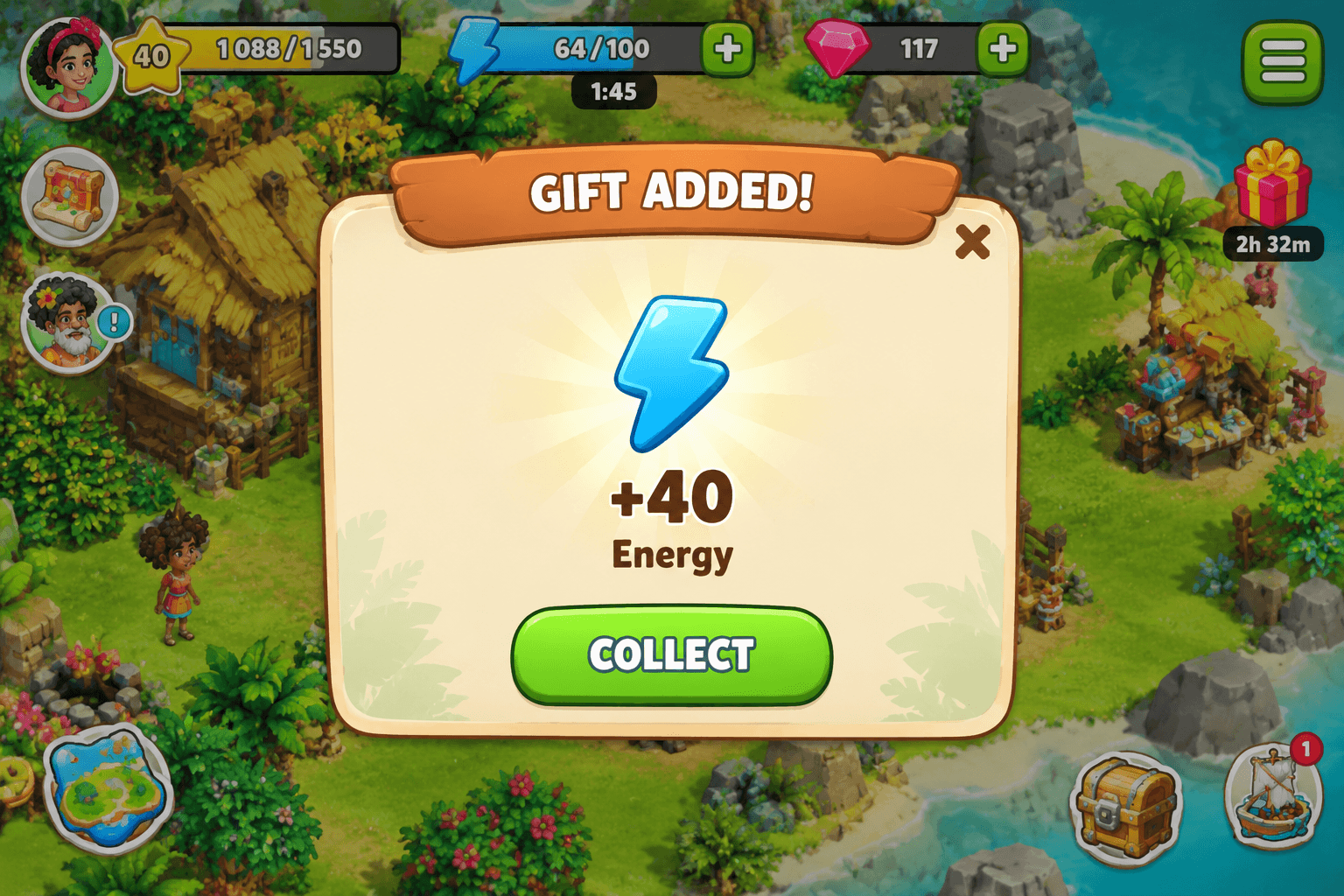
1. Never sit at a full bar
Energy comes back at 1 point every 2 minutes, and the timer stops when you’re capped. Before you leave the game, spend a little so the clock keeps running. With a cap of 80, four hours at full is 40 energy gone.
2. Upgrade the House
Every tier lifts your cap, which lets you stay offline longer without waste. It’s the safest long term energy investment on the Home Island.
3. Salt decides your food
Salt is the bottleneck, so judge meals per salt, not per recipe. Players report a sandwich gives about 65 energy for 1 salt, while Creamy Soup gives about 60 for 2. When salt runs low, cook sandwiches. Don’t trade salt to the Merchant.
4. Stockpile bread and cheese, not meals
Dining table slots are limited, but ingredients sit in your general inventory. Cook them into sandwiches when you need a burst, for example right before a booster window.
5. Watch the ad when you serve a meal
Reportedly it lifts a three sandwich meal from about 195 to about 249 energy. Check the numbers in your own game. If they match, it’s the easiest free energy you’ll find.
6. Skip bathroom and shower repairs.
They reportedly give about 20 to 25 energy before breaking, and the wood, stone and crafted parts to fix them cost more energy than they return. Many veterans let them break and park them at the edge of the island so they don’t tap them by accident. Check the repair cost in your game before you decide.
7. Merchant first, Shaman second
The Merchant takes crafted goods for energy (reportedly 60 to 150) and Gold Keys. Keys open chests and gates on event islands, so they matter. If his ask is too heavy, send him away. Players report there’s no penalty, and he returns with a new offer. The Shaman works the same way, and he’s best used when you have spare animal goods and need salt.
8. Check cost per item before you swing
Tap the magnifying glass next to a crafting item and the camera jumps to the best node. Bigger isn’t always cheaper. Players report this iron example: a small node costs 36 energy for 2 ore (18 each), a medium costs 99 for 4 (24.75 each), and a large costs 165 for 7 (about 23.6 each). Check your own numbers, but the habit is the point.
9. Event islands: hit and run
The early obstacles are cheap, the blue boxes pay, and the final ones cost thousands. Open the blue boxes, use your keys, and stop the moment the next obstacle costs more than it returns. Finishing broke is not a win.
10. Wait for boosters
Boosters reportedly run 15 to 60 minutes. An Axe Booster doubles what a node gives for the same energy. A Blue Box Booster adds extra energy to blue boxes. Scout the map, mark the big nodes, leave them, and strike when the booster goes live.
11. Find the Pink Bag without guessing
Most event maps hide a bag under one obstacle, and it pays a big energy and Ruby reward. Look up the location on r/FamilyIsland before you spend a point. Players say to expose it, then wait for a Blue Box Booster before opening, to multiply the payout.
12. Ignore low tier card album trades
Players report a deal that costs 60 duplicate points for a 1 star pack and 25 energy. Save points for the guaranteed higher star packs.
13. Invite friends only if you mean it
Reportedly, you get 100 energy and 50 Rubies when an invited friend reaches Level 4. Check the current reward in your game.